
SCADA control cabinet acts as the central brain, integrating supervisory control and data acquisition (SCADA) software to run an entire industrial refrigeration system transparently and accurately. Tan Long specialises in designing and building SCADA control cabinet dedicated to cold stores, IQF freezing systems and seafood processing plants, meeting IEC 61131-3 strictly with enclosure ratings from IP54 to IP65.
In the context of modernisation, applying a SCADA control cabinet not only allows multi-point temperature monitoring in real time but also optimises the control of refrigeration compressors and evaporators while storing operating data for risk control. The page below gives a detailed view of the construction, the operating principle and the installation process for control cabinets to international standards at Tan Long.
What is a SCADA control cabinet in an industrial refrigeration system?
SCADA control cabinet in a refrigeration system is the command centre integrating a PLC, an HMI screen, communication modules and dedicated software. Its job is to collect data continuously from temperature and pressure sensors and equipment status, then automatically control actuators such as solenoid valves, refrigeration compressor and evaporator fans precisely.
The structure of a SCADA control cabinet system has two layers working in parallel to ensure stability:
- Local control layer (handled by the PLC control cabinet ): Processes I/O signals from the sensors, executes the programmed logic and reacts to a fault in under 100 milliseconds (ms).
- Supervisory layer (handled by the SCADA software): Displays a live P&ID diagram, records operating history, sends alerts by email or SMS and allows remote management over LAN or 4G/5G.
In practice, for industrial cold stores of 500 kW to 2,000 kW, the Tan Long SCADA control cabinet solution allows 32 to 256 measuring points to be tracked at once. The parameters include cold chamber temperature, high and low side pressure and the operating status of the industrial refrigeration, helping the business control risk and optimise electricity cost effectively.
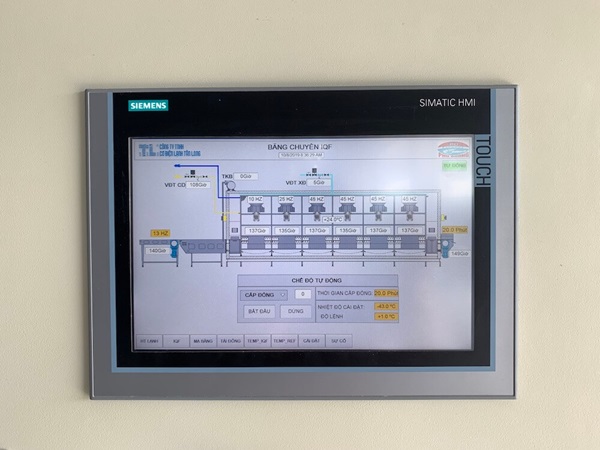
Applications of the SCADA control cabinet across refrigeration system types
In Vietnam, the Tan Long SCADA control cabinet solution is a specialist choice, widely deployed in four key application groups in industrial refrigeration:
- Multi-chamber cold stores and freezer stores: The SCADA system monitors the temperature of each individual chamber, coordinates the central compressors to the actual load, and defrosts the evaporators automatically on schedule or by frost sensor. A typical 5,000-tonne cold store has 10 to 20 chambers, requiring SCADA to track 80 to 150 temperature points at once.
- IQF freezing systems and contact plate freezers: An IQF belt freezer requires the freezing chamber temperature to be held between -35°C and -45°C (-31°F to -49°F) with ±1°C stability. SCADA records the freezing time of each batch, the belt speed and the electricity consumption per production shift, producing HACCP-compliant data for export customers.
- Chillers and process water cooling systems: SCADA control cabinet regulates the water chiller according to variations in the production cooling load. The SCADA cabinet controls the chiller to the varying load, holding the outlet chilled water between 5°C and 12°C (41°F to 54°F) for food production, or 15°C to 20°C (59°F to 68°F) for industrial air conditioning. The system optimises electricity consumption by adjusting compressor speed through an inverter (VFD) based on the actual temperature feedback.
- Multi-station refrigeration systems and multi-site plants: A seafood group or a cold store chain operating several facilities in different provinces can integrate them all into one central SCADA system, accessed through a web browser or a mobile app, with no need to send a technician to each site to read the figures.
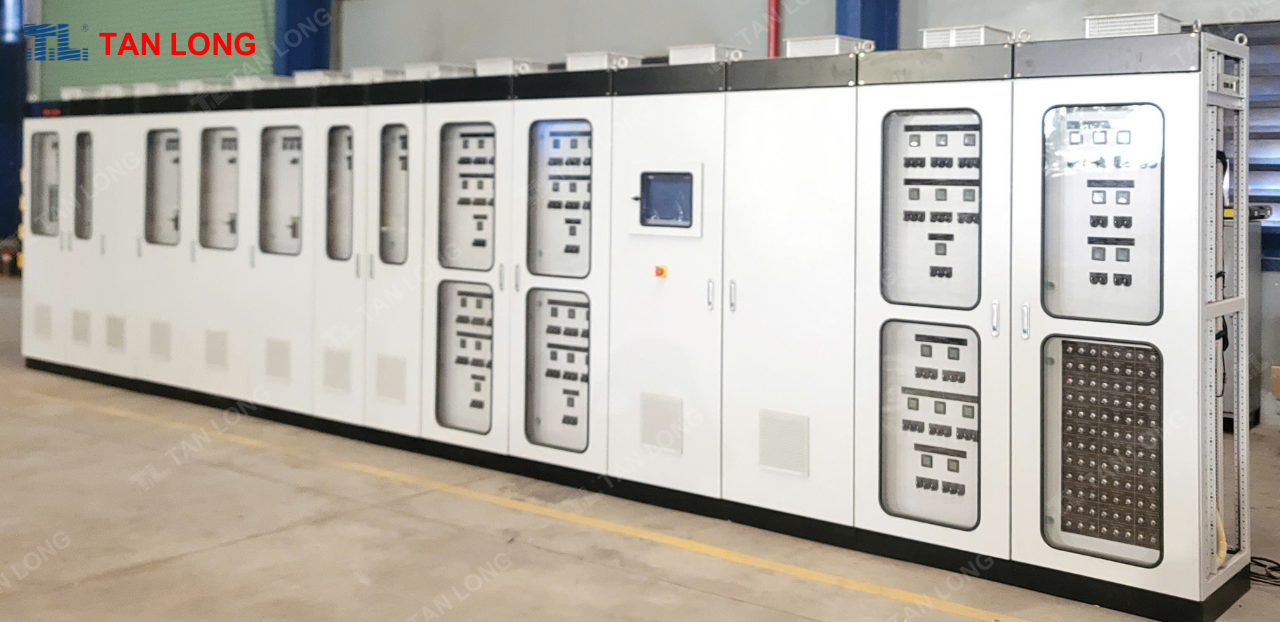
Construction of the SCADA control cabinet for industrial refrigeration systems
SCADA control cabinet designed and installed by Tan Long is built from six main components, ensuring coordination across the refrigeration system control and monitoring chain:
- Programmable logic controller (PLC): This is the central brain processing all the control logic. Tan Long integrates PLC control cabinet ranges from Siemens (S7-1200, S7-300), Mitsubishi (FX5U, Q-series) or Delta. With a scan time of 0.1 ms to 1 ms, the PLC lets the SCADA control cabinet react instantly to temperature and pressure alarms, keeping the system safe.
- HMI (Human-Machine Interface) screen: The direct interface for technicians to work with the system. Screens range from 7 to 21.5 inches with high resolution. Tan Long programs a custom interface to the actual layout, giving a clear display of the cold storagetemperature, the refrigeration compressor status and operating graphs.
- Expansion I/O modules: These receive signals from PT100/PT1000 temperature sensors, 4-20mA pressure sensors and status relays. The SCADA control cabinet system can expand from 16 to 512 I/O points depending on the scale of the project.
- Integrated communications: Supports a range of protocols such as Modbus TCP, Profinet and Ethernet/IP. In particular, the system allows remote connection over LAN, WiFi or 4G/LTE, so the investor can monitor the industrial refrigeration system anywhere, any time, from a mobile phone.
- Enclosure and protective structure: Made from powder-coated steel or 304 stainless steel, rated IP54 to IP65. This design lets the SCADA control cabinet work reliably in the wet environment of a seafood processing plant or harsh refrigeration equipment areas.
- Power supply and protection devices: Comprising a main breaker (32A – 630A), a 24VDC backup UPS and an EMC noise filter. These components protect the sensitive electronics inside the SCADA control cabinet from electromagnetic interference caused by the compressor motors.
Technical standards applied to the SCADA control cabinet
Equipment supplied by Tan Long is manufactured to the following standards and material requirements:
- HACCP
- ISO
- IEC
- NH3 refrigerant
- IP protection rating
Depending on each project's requirements, the engineering team will advise on the material configuration and connection standards that best suit the plant's existing system.
The SCADA cabinet supply and installation process at Tan Long
Tan Long carries out the whole SCADA cabinet supply chain from design to operation, with no intermediary, ensuring clear delivery times and clear technical responsibility.
- Step 1: Survey and requirements gathering (3 to 5 working days). Tan Long engineers visit the site to measure the system layout, determine where the cabinet will go, list the equipment to be connected, and confirm the SCADA interface requirements with the customer operating team.
- Step 2: Technical design and approval (5 to 10 working days). Tan Long issues the CAD electrical drawings (single-line diagram, wiring diagram, equipment layout inside the cabinet), the bill of materials with origins, and a sample HMI/SCADA interface design for the customer to approve before manufacturing.
- Step 3: Cabinet manufacturing and programming (15 to 30 working days). The cabinet is built at the Tan Long workshop to the approved drawings. At the same time, programmers write the PLC program and configure the SCADA software. Before despatch, the cabinet goes through a FAT (Factory Acceptance Test): insulation testing at ≥ 1 MΩ, functional testing of each I/O, and alarm simulation.
- Step 4: Installation and wiring on site (5 to 10 days). Tan Long technicians install the cabinet, run the cabling from the cabinet to each field device, and connect the sensors. A no-load test run then confirms the signal on each I/O channel before the whole system is energised.
- Step 5: Acceptance and operator training (1 to 2 days). Tan Long performs the SAT (Site Acceptance Test) with the customer representative: checking each measuring point, checking the alarms and the remote control functions, and training the operating team to use the SCADA interface. The acceptance records, as-built drawings and operating manuals are all handed over.
Tan Long SCADA control cabinet specifications
To ensure accurate operation for systems such as the IQF flat conveyor belt or large refrigeration compressor sets, Tan Long designs the SCADA control cabinet to internationally standardised specifications:
| Specifications | Detailed value |
| Product name | SCADA control cabinet (dedicated design) |
| Supply voltage | 380VAC 3 pha / 220VAC 1 pha, 50Hz |
| Control voltage | 24VDC (standardised for safety across all I/O) |
| Base I/O points | 32 DI + 16 DO + 8 AI + 4 AO |
| Maximum I/O expansion | Up to 512 points (via dedicated expansion modules) |
| Enclosure protection rating | IP54 (standard) / IP65 (for wet environments) |
| Enclosure material | 304 stainless steel or powder-coated steel RAL 7035 |
| Communication protocol | Modbus RTU, Modbus TCP/IP, Profibus DP, Ethernet/IP |
| Remote monitoring connection | LAN, WiFi, 4G/LTE (optional cloud management) |
| Integrated PLC brand | Siemens, Mitsubishi, Delta, Omron (chosen per project) |
| Cabinet size (H×W×D) | From 600×400×200 mm to 2,200×800×600 mm |
| Manufacturing standard | Complies with IEC 61131-3, IEC 60204-1 |
| Warranty policy | 18 months on hardware and 12 months on software |
Beyond the standard specifications above, the Tan Long SCADA control cabinet solution also integrates very large data storage, supporting temperature history retrieval for cold storage to HACCP and ISO standards. Using components from specialist brands keeps the system stable and minimises downtime for the business.
Why choose Tan Long for a refrigeration SCADA control cabinet
Tan Long specialises in supplying industrial refrigeration equipment and systems in Vietnam, with more than 15 years of experience building control cabinets for cold stores, freezing plants and industrial refrigeration systems.
The technical difference at Tan Long is that the SCADA cabinet is designed together with the refrigeration system from the start, rather than ordering a generic cabinet and bolting it on. Tan Long engineers understand the operating logic of Bitzer, Copeland and Mycom compressors, understand the seafood freezing process and HACCP requirements, and so program SCADA to reflect the real operating process rather than copying a generic template.
Tan Long provides an 18-month warranty on the cabinet and 12 months on the SCADA software, with 24/7 remote technical support over a VPN connection into the customer SCADA system. Spare parts (relays, breakers, PLC modules) are always in stock at Tan Long, ensuring system recovery in under 24 hours in the event of a fault.
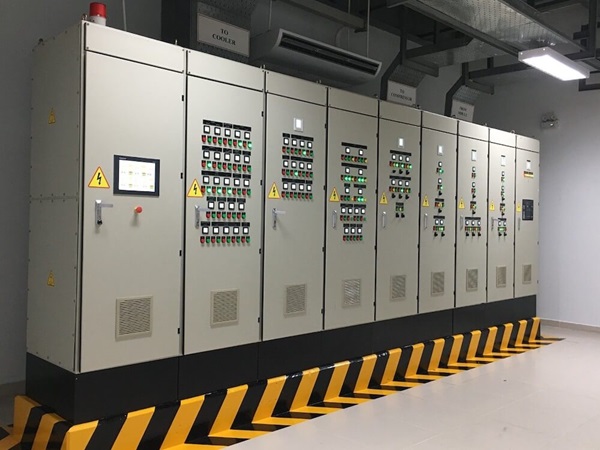
Contact the Tan Long engineering team for advice on designing a SCADA control cabinet to the scale and specific requirements of your industrial refrigeration system.
A SCADA control cabinet moves a refrigeration system from manual operation to automatic monitoring, reducing operator error, shortening the time to detect a fault, and providing data that complies with international standards. Tan Long designs and builds SCADA cabinets integrated deeply with the specifics of each industrial refrigeration system, from a 500-tonne cold store to an IQF freezing plant for export.
Contact the Tan Long engineering team today for advice on the SCADA cabinet solution that matches the real requirements of your industrial refrigeration system.
How a SCADA system works in cold stores and freezing plants
System SCADA control cabinet works on a three-layer architecture: the field device layer, the control layer (PLC) and the supervisory layer (SCADA server/client).
At the field device layer, PT100 temperature sensors in the cold chamber send a resistance signal to the PLC I/O module every second. The pressure sensor on the compressor suction line sends a 4-20 mA signal corresponding to 0-25 bar (0-362 psi). When the chamber temperature exceeds the setpoint — for example -18°C ± 2°C for a freezer store — the PLC immediately starts the compressor and the evaporator fans through the output relays.
At the control layer, the PLC runs PID control algorithms to hold the temperature steady, a lead-lag compressor load distribution algorithm to balance running hours between compressors, and high and low pressure protection logic to stop a compressor before damage occurs.
At the supervisory layer, the SCADA control cabinet software receives data from the PLC over Modbus TCP every 500 ms, writes it to a database once a minute, and displays the system diagram live on a computer or phone screen. Technicians access 12 months of history to analyse electricity consumption trends, detect declining compressor performance and plan preventive maintenance.
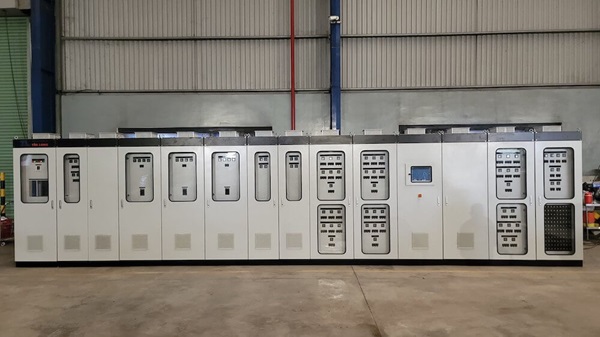
SCADA control cabinet versus PLC control cabinet
The choice between a PLC control cabinet and a SCADA control cabinet depends on the functional scope and the scale of the project rather than on a basic difference in technology.
- PLC control cabinet: Focused on local automatic control. The system receives sensor signals and executes commands based on pre-programmed logic. It is the optimal solution for small and medium industrial refrigeration systems (50 kW to 500 kW) that need a high level of automation but no central multi-station monitoring.
- SCADA control cabinet: A higher level that includes all the PLC functions but adds the central supervisory layer. SCADA control cabinet allows data collection, historical storage, a live P&ID display and remote control over the internet. This system is essential for large cold stores (above 500 kW) or groups of plants that need central management from a single control room.
In practice at Tan Long, cold store projects above 1,000 tonnes of goods and seafood processing plants for export always prefer a SCADA control cabinet. The core reason is temperature traceability — a demanding requirement for HACCP and international BRC Food certification.
Criteria for choosing the right SCADA control cabinet for a refrigeration system
Choosing the right specification for a SCADA control cabinet directly determines the long-term operating performance and maintenance cost of the whole industrial refrigeration system. Below are the 5 key technical criteria an investor should settle before design begins:
- System scale and number of I/O points: This is the first step in configuring the hardware for the SCADA control cabinet. You need a complete count of temperature and pressure sensors and actuators. A practical rule at Tan Long is always to multiply the current I/O count by a 1.3 spare factor to allow for later expansion. For example, a 100 kW system needs at least 32 I/O, while a large 1,000 kW system requires 128 to 256 I/O.
- Communication requirements and integration: SCADA control cabinet must be able to talk smoothly to the existing equipment. Tan Long usually recommends Modbus TCP or Profinet for new equipment to achieve high speed. In particular, if the system uses refrigeration compressors with integrated inverters, the PLC in the SCADA cabinet must be able to read parameters over Modbus or PROFIBUS for energy optimisation.
- Protection rating and installation environment: The enclosure of the SCADA control cabinet is designed differently depending on the installation area. For a dry electrical room, IP54 is sufficient; however, in areas cleaned frequently or with high humidity such as a seafood processing plant, Tan Long prefers IP65 with 304 stainless steel to resist corrosion.
- Data storage and reporting capability: For food exporters, the SCADA control cabinet must store at least 12 months of temperature data as required by BRC Food Issue 9 or HACCP. The Tan Long system allows large-capacity storage (around 50GB per 100 measuring points per year), supporting fast report retrieval for audits.
- Maintenance availability and technical support: You should choose a common PLC platform such as Siemens, Mitsubishi or Delta so that replacement parts are always available. Tan Long commits to technical support for the SCADA control cabinet and the PLC control cabinet within 24 hours, minimising cold store downtime.
Frequently asked questions about SCADA control cabinets
Can a SCADA cabinet be monitored remotely by phone?
Yes. Tan Long SCADA cabinets support remote monitoring through a mobile app or a web browser, using the local LAN or an optional 4G/LTE module. Technicians follow temperature, pressure and equipment status in real time from anywhere, and receive alerts by SMS or email when a threshold is exceeded.
What platform does the SCADA software use, and is a licence required?
Tan Long uses SCADA software from Ignition (Inductive Automation), WinCC (Siemens) and FactoryTalk (Rockwell) depending on the project requirements. The software licence cost is included in the project value and the customer owns the licence after handover. Tan Long also offers an open-source SCADA solution on Node-RED and InfluxDB for projects optimising operating cost.
Does the SCADA system store temperature data for HACCP reporting?
Yes. Tan Long SCADA stores temperature data at intervals from 1 minute to 15 minutes, retained for at least 12 months as required by BRC Food Issue 9 and FSSC 22000. The system exports temperature reports as PDF or Excel by day, week, month or batch, suitable for submission to a food safety audit.
How long does installing a SCADA cabinet take?
From contract signing to handover and live operation is usually 30 to 60 days, depending on the scale and complexity of the system. Refrigeration systems under 500 kW are usually complete in 30 to 45 days. Large systems above 1,000 kW with many cold chambers and multi-point SCADA requirements need 45 to 60 days.
Roughly what does a SCADA cabinet cost?
The cost of a SCADA cabinet depends on the number of I/O points, the PLC platform, the SCADA software and the required protection rating. Contact Tan Long for a detailed quotation after a site survey. Tan Long provides a preliminary technical design free of charge for projects of 500 kW and above.
Request advice and a quotation
Tan Long designs and builds industrial refrigeration equipment at its plant in Duc Hoa 1 Industrial Park, Tay Ninh (formerly Long An), so capacity and dimensions can be adjusted to the actual site. Call 0933 357 058 (Mr. Thinh) or send a quotation request with your output per shift and your main product type.


