
Industrial cold storage (cold storage) is an engineered facility that uses a mechanical refrigeration system to hold a controlled temperature in an enclosed space, from 5°C down to -40°C (41°F down to -40°F), to preserve goods, food, pharmaceuticals and agricultural produce. Tan Long designs and builds cold stores to HACCP standards, using PIR and PU insulated panels, industrial refrigeration compressors and PLC/SCADA control systems to keep operation stable 24/7.
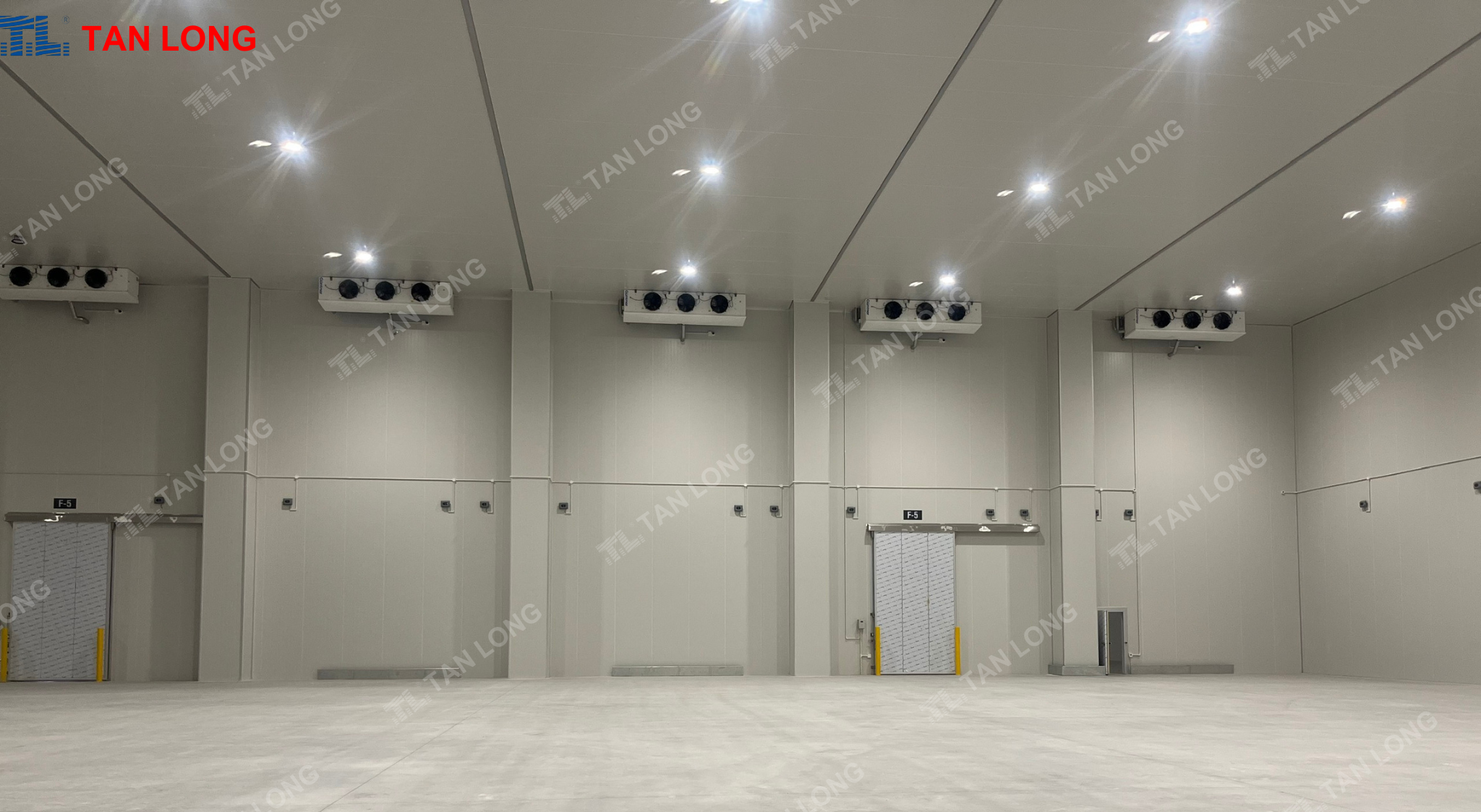
A cold store is built from four core components: the enclosure (insulated panels), the refrigeration system (compressor, condenser, evaporator), the temperature control system, and the insulated doors. Each one has a direct effect on energy performance and operating life. Tan Long provides a turnkey design solution: from advising on storage capacity and selecting the refrigerant (R404A, NH3/R717, R134a) through to installation and periodic maintenance.
What is a cold store? Operating principle and technical standards
Cold storage is an enclosed space built with a special insulated structure. Inside it, the mechanical refrigeration system continuously removes heat from the storage chamber to hold the optimal temperature range required (from 5°C to -40°C).
In principle, a cold storage works on a closed vapour compression cycle: the refrigerant (such as R404A or NH3) absorbs heat at the industrial refrigeration, is then raised to high pressure by the refrigeration compressor, releases heat at the condenser and passes through the expansion valve to begin a new cycle.
To ensure operating efficiency and optimise electricity cost, a standard Tan Long cold storage system always focuses on three core technical factors:
- Superior insulation performance: Use the system cold storage panel standard 100mm PIR/PU. With an R-value of around 6.5 m²K/W, this structure minimises heat ingress from the environment and meets HACCP requirements for food storage.
- Optimal system capacity: At Tan Long, capacity is calculated precisely from the actual heat load (from 10 tonnes to 12,000 tonnes), including the heat in the goods and the operating factors, so the system runs stably and durably.
- Airtightness and dedicated fittings: Particularly for freezer rooms below -18°C (0°F), fitting tightly sealing cold storage doors is extremely important. It prevents condensation and ice build-up, protecting the life of the evaporator and maintaining maximum cooling performance.
Which industries use cold storage?
Currently, cold storage is the backbone of the supply chain in Vietnam. Depending on the characteristics of the goods, Tan Long designs systems to distinct technical standards for each segment:
- Seafood and food processing is the largest segment in Vietnam. Shrimp, fish, squid and octopus require freezer rooms at -18°C to -25°C. Export processing plants need storage capacities from 500 tonnes to 5,000 tonnes, with clear zoning between the raw material receiving area (0°C to 4°C), combined with a wind tunnel or IQF conveyor high-speed freezing system (-35°C to -40°C), and the finished goods store (-18°C to -22°C).
- Vegetables, fruit and agricultural produce need chill rooms at 0°C to 10°C with relative humidity (RH) controlled between 85% and 95%. Many tropical fruits such as mango, dragon fruit and banana need to be stored in a cold storage for vegetables and require controlled atmosphere (CA), where the O₂ concentration is lowered to 2% to 5% and CO₂ raised to 3% to 8% to slow respiration and extend storage life by a further 30% to 50%.
- Pharmaceuticals and healthcare require a GSP cold store (Good Storage Practice) under Circular 36/2018/TT-BYT. Vaccines and biologicals are usually stored at 2°C to 8°C, while some specialist medicines require -20°C. The core of the Tan Long solution is an integrated PLC control cabinet with intelligent 24/7 temperature alarms and a backup power system to keep biologicals absolutely safe.
- Logistics and cold distribution is growing strongly in Vietnam, driving demand for cold storage commercial cold stores, which are shifting to the multi-temperature model. This design allows several product groups to be stored in one building, optimising land area and reducing investment cost. With experience on projects up to 12,000 tonnes, Tan Long delivers complete cold storage design solutions that run reliably and save electricity.

Common types of industrial cold store
Industrial cold stores fall into three main types by operating temperature range, each serving a different storage purpose:
- Chill room (cooling room) operates between 0°C and 15°C (32°F to 59°F), suitable for fresh vegetables and fruit, cut flowers, pharmaceuticals and beverages. This range inhibits aerobic bacteria without freezing the product. PU insulated panels 75 mm to 100 mm (3 to 4 inch) thick are the common standard for this segment.
- Freezer room holds a temperature of -18°C to -25°C (-0.4°F to -13°F), meeting the storage requirements for seafood, meat, poultry and processed foods needing deep freezing. FDA and Codex Alimentarius standards require frozen food to reach and hold -18°C to prevent the growth of pathogenic micro-organisms. PIR panels 150 mm to 200 mm (6 to 8 inch) thick are used for freezer rooms to provide the necessary insulation performance.
- Deep freeze storage operates at -30°C to -40°C (-22°F to -40°F), used for export shrimp, ocean tuna and some medical biologicals. At this range, NH3 (ammonia/R717) or an R404A/CO₂ cascade system is preferred, being 15% to 20% more energy efficient than a conventional Freon system at the same cooling load.

Cold store system construction to technical standards
A complete industrial cold store comprises five integrated technical systems:
- Insulated panel form the enclosure of the store. PU (polyurethane) panels have a core density of 40 kg/m³ to 42 kg/m³ and a thermal conductivity of λ = 0.022 W/mK, suitable for chill rooms and standard freezer rooms. PIR (polyisocyanurate) panels achieve λ = 0.020 W/mK with better heat resistance, and are preferred for deep freezer stores and projects with fire protection requirements. The panel facing is colour-coated galvanised steel or 304 stainless steel, meeting HACCP food hygiene requirements.

- System refrigeration compressor is the heart of the refrigeration cycle. Tan Long uses screw compressors for stores of 100 tonnes and above, and reciprocating compressors for smaller stores. Compressor capacity is calculated from the total heat load: Q = Q₁ (heat in the product) + Q₂ (heat ingress) + Q₃ (operating heat), with a minimum 15% safety margin.
- Unit cooler (evaporator) distributes cold evenly through the chamber. In a freezer room, the evaporator runs an electric or hot gas defrost cycle every 4 to 8 hours depending on the moisture load of the stored product. The Tan Long fishbone evaporator suits stores longer than 30 m (98 ft), giving even air distribution along the whole length of the store.
- Cold storage door must be completely airtight. Tan Long supplies T-Light sliding doors with four-sided magnetic gaskets, a heated door frame to prevent condensation, and an automatic opening system. High speed doors are fitted at frequently used loading areas, with an opening and closing speed of 1.5 m/s to 2 m/s, reducing heat loss and increasing productivity.

- PLC/SCADA control cabinet monitors and controls the whole system. The SCADA system allows the actual temperature to be followed at multiple measuring points, raises alarms by SMS or email, and stores temperature history for the traceability required by European and American importers.
Refrigerants for cold storage: R404A, NH3 and the green transition
The choice refrigerant not only has a direct effect on operating cost but also determines the safety of the system and its ability to comply with international regulations cold storage. Tan Long currently works with the three most common refrigerant groups — R404A, NH3 (R717) and R134a — each with its own technical characteristics:
- R404A is a synthetic HFC refrigerant: non-toxic, non-flammable and easy to operate. The GWP (Global Warming Potential) of R404A is 3,922, the highest among industrial refrigerants. The EU F-Gas Regulation (EU 517/2014) and the Kigali Amendment schedule are pushing R404A out of the European market, with carbon charges rising from 2025. This is a point to note for plants exporting to the EU.
- NH3 (amoniac, R717) is a natural refrigerant with GWP = 0, 15% to 30% more energy efficient than R404A across the same temperature range, cheaper as a refrigerant and with no effect on the ozone layer. NH3 is toxic above 25 ppm and requires a leak detection system, forced ventilation and a separate machine room under TCVN 6739:2018. Tan Long has experience designing NH3 systems for cold store projects above 500 tonnes, including the 12,000 MT cold store for Frescol Tuna Vietnam in Nghe An.
- R134a and newer HFO refrigerants such as R448A and R449A are being applied to medium-scale chill and freezer rooms, with a GWP 70% to 80% lower than R404A, meeting the green roadmap of many international food groups.
Cold store design standards: HACCP, TCVN and the real installation process
At Tan Long, cold storage design done properly always starts from a detailed heat load calculation rather than simply picking equipment off the shelf. A durable system has to be based on an analysis of all the technical factors together, to avoid undersizing the machinery, which causes overload and early failure. The core parameters are:
- The U-value of the cold store panel system and the area of the enclosing structure.
- The specific heat and the actual weight of goods entering the store in each consignment.
- The opening frequency of the cold storage door and the heat lost while goods move in and out.
- The heat given off by the lighting, the people and the fan motors of the industrial evaporators.
To ensure safe operation and meet demanding export conditions, every cold storage project Tan Long delivers complies strictly with national and international standards. We apply TCVN 6739:2018 for refrigeration system safety, TCVN 5687:2010 for ventilation and, in particular, the HACCP requirements of the Codex Alimentarius for food. For projects serving the EU market, the system is also optimised to meet EC 853/2004. In healthcare, our solutions are committed to meeting the most demanding GSP standard of the Ministry of Health.
With our own plant in Duc Hoa 1 Industrial Park (Tay Ninh, formerly Long An), Tan Long runs a professional cold storage installation process in 5 closed stages, keeping to a schedule of 45 to 60 days for projects of 100 to 500 tonnes:
- Survey and technical design: Preparing the detailed M&E drawings and the panel layout based on the actual floor area.
- Equipment manufacturing and supply: Producing the PIR/PU enclosure and assembling the refrigeration compressors to the approved configuration.
- Structural installation on site: Erecting the frame and assembling the insulated panel system to ensure complete airtightness.
- Control system installation: Integrating the PLC/SCADA control cabinet for temperature monitoring and intelligent automatic operation.
- Commissioning and handover: Test running the system, tuning the parameters and handing over the complete as-built technical documentation to the customer.

The cold store consulting and installation process at Tan Long
To ensure the system runs reliably with the highest cooling performance, Tan Long Refrigeration and Electrical Engineering Joint Stock Company applies a strict delivery process, combining manufacturing capability at the Duc Hoa 1 plant with an engineering team of more than 20 years of experience. A standard cold storage project goes through the following steps:
- Survey and solution consulting: Engineers measure the site and establish the type of goods to be stored, then advise on the temperature range, the dimensions and the capacity of the refrigeration compressor most suitable
- In-depth engineering design: Dedicated software is used to calculate the cooling load and lay out the insulated panels and the installation diagram for the industrial refrigeration to optimise air circulation.
- Equipment manufacturing and supply: The complete PU/EPS enclosure and the T-Light cold storage door and PLC control cabinet are fabricated and quality checked at the workshop before being shipped to site.
- Installation on site: The technical team assembles the enclosure, connects the copper pipework, installs the compressor and condenser sets and adjusts the safety protection devices.
- Acceptance and handover: The system is test run to check temperature stability and energy saving, and detailed operating instructions are given to the customer before it goes into service.
Latest cold store installation price guide
The cost of installing a cold storage system depends on several factors: the volume of the store, the required temperature range, the panel thickness and the equipment brands (Mycom, Bitzer, Güntner and so on). To help you budget, Tan Long offers the following preliminary reference table for the various types of cold storage popular:
| Warehouse type | Temperature range | Insulation material | Main equipment | Reference price |
| Cold storage for agricultural products | 0°C to 15°C | Panel EPS/PU | Genuine branded compressor | Contact us for a quote. |
| Cold store for seafood | -18°C to -25°C | Panel PU 100mm | Two-stage compressor set | Contact us for a quote. |
| GSP store (pharmaceutical) | 2°C to 8°C | High-density PU panel | PLC/IoT control system | Contact us for a quote. |
| High-speed air blast freezing tunnel | -35°C to -45°C | Panel PU 125-150mm | Air Blast Tunnel Freezers dedicated | Contact us for a quote. |
Note: For a detailed and accurate installation quotation for cold storage in your area (Ho Chi Minh City, Tay Ninh or the Mekong Delta provinces), please send us your specific technical parameters so our engineering team can prepare a solution optimised for long-term operating cost.
The factors that determine cold store investment cost
There is no single price for every cold store: the same volume at a different temperature range, or with a different daily intake, gives a different heat load — and therefore a different equipment configuration and cost. Below are the factors that determine the final figure in a quotation:
- Operating temperature range. A chill room and a deep freezing store differ enormously in refrigeration capacity per cubic metre; this is the single strongest influence on price.
- Volume and shape of the floor plan. A square floor plan uses less enclosure material than a long narrow one at the same volume.
- Thickness and type of insulated panel. A thicker panel raises the investment cost but lowers the electricity bill over the whole life — it has to be judged on total cost, not purchase price alone.
- Daily intake and the temperature of goods at intake. These two figures determine the real heat load, and they are often missed in a quick estimate based on floor area.
- Refrigeration system configuration. Single or two-stage, NH3 or Freon, water-cooled or air-cooled — each choice changes both the investment and the running cost.
- Door type and fittings. Sliding, hinged or high speed doors; and whether a deep freezer store needs frame heater wire.
- Standards required. A GSP store or one serving export goods needs a monitoring system, backup power and assessment documentation — items an ordinary store does not have.
- Site conditions. The foundation, the available electrical supply, the access route for the equipment and the distance to the site.
This is why Tan Long does not publish a fixed price list. After surveying the site and calculating the heat load under the actual operating conditions, we quote to the configuration proposed and state the scope of work clearly, so you can compare it against other offers.
Why the cheapest quotation is not always the cheapest solution
Electricity accounts for most of the life-cycle cost of a cold store. A lower investment using thin panels, low-efficiency equipment or poorly sealing doors can cost significantly more after a few years of operation. When comparing quotations, compare on the same configuration: the same temperature range, the same panel thickness, the same equipment type and origin, and the same scope of work.
Tan Long cold store specifications and scope of supply
When you choose Tan Long, you are advised on the cold storage solution best suited to your actual heat load. We supply the complete package, from cold store design through equipment supply to full installation, to international standard specifications:
| Parameter | Scope | Note |
|---|---|---|
| Operating temperature range | +15°C to -40°C (59°F to -40°F) | Depending on the product being stored |
| Storage capacity | 10 tonnes to 12,000 tonnes (11 to 13,228 US tons) | Custom design |
| Wall/ceiling panel | PU 75mm, 100mm, 150mm, 200mm | Core density 40-42 kg/m³ |
| PIR Panel | 100mm, 150mm, 200mm | λ = 0.020 W/mK |
| Refrigerant | R404A, R448A, R449A, NH3 (R717) | Advice following the GWP roadmap |
| Compressor | Screw, reciprocating | Capacity calculated from the actual heat load |
| Control system | PLC, SCADA, remote monitoring | SMS/email alarms, temperature logging |
| Warehouse door | Sliding, hinged and T-Light high speed | Magnetic gaskets, heated frame |
| Standard | HACCP, TCVN 6739:2018, GSP | Audit documentation support on request |
Which industries does Tan Long supply cold stores for
The same temperature range still differs by industry in pull-down speed, how the store is zoned, and the acceptance documentation that has to be submitted. That is why Tan Long supplies cold stores to the specifics of each industry rather than applying one generic design:
- Seafood cold storage — an export processing plant needs clear zoning from receiving and freezing -35°C to -40°C through to the finished goods store -18°C to -22°C. A break in the cold chain at any stage downgrades the consignment.
- Agricultural Cold Storage — the problem is holding stock past the season and controlling humidity, not only lowering the temperature. Each produce group has its own threshold, and going outside it damages the structure.
- GSP Pharmaceutical Cold Storage — the 2°C to 8°Crange, with mandatory temperature mapping, alarms and backup power. The hardest part is not the equipment but the assessment documentation.
- Logistics and Distribution Cold Storage — a multi-temperature store divided into several chambers for several goods owners, with a very high door opening frequency, so the door and air curtain design determines the electricity cost.
For companies installing themselves or replacing individual parts, Tan Long also supplies cold storage insulated panels and industrial cold storage materials manufactured at our own plant.
Why choose Tan Long to design and build your cold store?
Tân Long là công ty cổ phần cơ điện lạnh với hơn 20 năm kinh nghiệm tại thị trường Việt Nam, thành lập năm 2005, nhà máy chế tạo thiết bị đặt tại KCN Đức Hòa 1, tỉnh Tây Ninh. Đây là một trong số ít đơn vị trong nước tự chế tạo thiết bị cấp đông — băng chuyền IQF, tủ đông, hầm đông — thay vì chỉ nhập khẩu rồi lắp đặt, giúp kiểm soát chất lượng chế tạo và chủ động tiến độ cung cấp.
In cold storage, Tan Long has completed landmark projects: a 12,000 MT cold store for Frescol Tuna Vietnam Co., Ltd in Nghe An (a complete NH3 system), a cold store for Lotte F&G Vietnam Co., Ltd at Long Hau Industrial Park (Tay Ninh province), a cold store for C.P. Vietnam Livestock Joint Stock Company in Cu Chi, and dozens of seafood cold store projects from 200 tonnes to 3,000 tonnes for plants in the Mekong Delta.
The Tan Long technical solution includes: M&E design to the actual heat load, advice on choosing a refrigerant in line with the environmental roadmap, PU/PIR panel manufacturing at our plant with foam quality control, installation of PLC/SCADA control systems with multi-point monitoring, and periodic maintenance after installation.

A cold store is a long-term investment and has to be designed correctly from the start. A mistake in compressor capacity or panel thickness stays with the building through 15 to 20 years of operation. Tan Long provides free technical consulting, calculates the real heat load, and supplies the M&E design documentation before the contract is signed.
- Cold store consulting: (+84) 933 357 058 (Mr. Thinh).
- E-mail:info@tanlongvn.com.
- Working hours: Monday to Saturday: 8:00 AM to 5:30 PM.
Large-scale cold stores delivered by Tan Long
- NECS – New Era Cold Storage, Tay Ninh: 102,642 pallet positions, several temperature levels from a +5°C chill room to -40°C deep freezing, with a total refrigeration capacity of around 3.05 – 3.08 MW on one central NH3 plant.
- AJ Total Vietnam – Long Hau Industrial Park: around 30,700 pallet positions, combining an automated ASRS freezer store over 40 m high with 05 conventional cold rooms using double-deep racking on the lower level.
Frequently asked questions about cold storage
How much does building an industrial cold store cost?
Industrial cold storage in Vietnam ranges from 15 million to 35 million VND per tonne of stored goods, depending on the temperature range, the scale, the location and any specific technical requirements. A chill room costs less than a deep freezer store because the panels are thinner and the refrigeration capacity smaller. Contact Tan Long for a heat load calculation and detailed quotation for your actual requirements.
What is the difference between a cold store and a chill room?
They differ in operating temperature range, and with it the panel thickness, the machine capacity and the investment cost. A chill room runs at 0°C to 5°C for vegetables, fruit and fresh goods. A frozen storage room runs at -18°C to -25°C for meat and frozen seafood. A deep freezer store runs at -35°C to -40°C for tuna and export goods that must keep their cell structure. At the same volume, a deep freezer store costs several times more to build than a chill room.
Should I choose PIR or PU panels for a cold store?
Panel PU có hệ số dẫn nhiệt λ = 0,022 W/mK, tỷ trọng lõi 40–42 kg/m³, phù hợp cho kho mát và kho đông phổ thông với chi phí hợp lý hơn. Panel PIR đạt λ = 0,020 W/mK và chịu nhiệt tốt hơn, được ưu tiên cho kho đông sâu và công trình có yêu cầu phòng cháy. Tân Long chỉ định panel theo dải nhiệt độ thiết kế của từng kho, thay vì lắp theo loại có sẵn trong kho hàng.
Should a plant cold store use R404A or NH3?
NH3 has GWP = 0 and is 15% to 30% more energy efficient than R404A across the same temperature range, which suits large plants with a dedicated operating team. R404A is easier to operate but has a GWP of 3,922 and is being restricted by the EU F-Gas Regulation and the Kigali schedule — a point to weigh for plants exporting to Europe. See the details on the NH3 refrigeration systems.
Is a cold store using NH3 safe?
NH3 is safe when the system is designed and operated to TCVN 6739:2018. An NH3 system requires: a machine room with forced ventilation (10 to 20 air changes per hour), leak detection sensors at four or more points, safety valves discharging to a water absorption vessel, and certified trained operators. An NH3 concentration above 300 ppm in air is life-threatening, but the odour detection threshold of 5 ppm to 25 ppm gives early warning well before the dangerous level is reached.
Can a cold store be built on soft ground?
A cold store on soft ground needs special ground treatment to avoid differential settlement and cracked panel joints. Common solutions include: reinforcing the ground with concrete piles, adding a floor insulation layer at least 150 mm thick to prevent the soil beneath a freezer store floor from freezing, and designing floor heating for deep freezer stores below -20°C. Tan Long advises on the specific ground solution based on the geotechnical survey for each project.
What periodic maintenance does a cold store need?
A cold store needs maintenance on two cycles: monthly servicing covers cleaning the condenser and checking the refrigerant pressure and the compressor oil condition; annual servicing covers checking panel tightness, measuring insulation resistance and replacing consumables (door gaskets, filters, compressor oil). A cold store not maintained on schedule risks losing 15% to 25% of its energy performance after 3 years of operation. See the details on the cold store maintenance.
Does Tan Long provide cold store maintenance after installation?
Yes. Tan Long provides cold store maintenance nationwide after installation, including monthly and annual maintenance contracts, repairs when a fault occurs, supply of genuine spare parts and materials, and remote technical support through the SCADA system. Tan Long also takes on maintenance of systems built by other companies after surveying their condition.
Does Tan Long supply turnkey cold stores?
Yes. Tan Long takes on the complete package from site survey, design and equipment manufacturing at our plant through installation and commissioning to handover and post-acceptance maintenance. The investor deals with a single point of contact, instead of splitting the contract between several contractors and then having to allocate responsibility when something goes wrong.
Which areas does Tan Long supply cold stores in?
Tan Long builds nationwide. In the key raw material regions in particular, our installation teams have local experience of ground conditions, power supply and equipment transport — see the details by area: Ca Mau, Bac Lieu, Soc Trang, Kien Giang, Tien Giang, Ba Ria – Vung Tau.
Related technical reading
- what a cold store is and how it works
- industrial cold store construction
- storage temperatures in a cold store by product group
- how to choose cold store dimensions by output
- cold storage design drawings
- how to calculate the refrigeration capacity for a store
Related pages
- Industrial cold store design consulting – load calculation, refrigerant selection, budgeting
- Turnkey industrial cold store installation contractor
- Industrial cold storage maintenance
- NH3 refrigeration systems – turnkey design and installation
- Cold storage doors – types and selection criteria
- 29 cold store projects delivered by Tan Long
- The range of industrial refrigeration equipment Tan Long designs and builds
- Design consultancy, installation and maintenance services for refrigeration systems


