
In an industrial cold store, the entrance door is the largest point of heat loss. Each time it opens and closes, cold air escapes and the refrigeration system has to make up the heat continuously, which increases the electrical load and shortens equipment life. The technical solution to this problem is the manual sliding insulated door, designed specifically for deep sub-zero environments. Tan Long supplies the T-Light sliding door line, used in food processing plants, chill rooms, freezer rooms and freezing tunnels nationwide. This page sets out the full technical characteristics, the construction and the reasons T-Light is the right choice for a company cold storage infrastructure.
What is a manual sliding insulated door?
The manual sliding insulated door is a dedicated door solution built from thick insulated panels that operates by moving horizontally on a sliding rail system instead of swinging on traditional hinges. The leaf is made from a high-density polyurethane (PU) core clad with powder-coated steel or durable 304 stainless steel, acting as a solid thermal barrier that separates the cold space from the outside environment completely. The operating mechanism of the manual sliding insulated door is particularly suited to cold storage systems with limited space, because it needs no clearance for a swinging leaf and opens or closes with a single light push or pull. The airtightness of the door depends entirely on the quality of the elastic rubber gasket and the precision of the mechanical suspension system. These are the two key factors that determine real temperature retention and energy saving for the whole system. Currently, the lines T-Light cold storage door in sliding form is widely used in fresh food storage rooms and vegetable chill rooms (0°C to 5°C). The equipment also operates stably in seafood freezer rooms (-18°C to -25°C) and in wind tunnel systems at extremely low temperatures down to -45°C. At meat and seafood processing plants, the Tan Long manual sliding insulated door is installed at every entrance to ensure strict temperature control for each production zone.

Key technical characteristics of the T-Light sliding door
The T-Light sliding door works across a temperature range from above zero down to minus 45°C (-49°F), covering every requirement of industrial cold storage in Vietnam from vegetable chill rooms to freezing tunnels for seafood exports.
- Heat loss control: A 40 kg/m³ PU layer with a low thermal conductivity, combined with an HDPE plastic thermal break frame, eliminates the thermal bridge through metal at the door edge. This is the difference from ordinary panel doors with no thermal break treatment, which suffer condensation and heat loss at the frame.
- Food hygiene standards: All materials in direct contact with the production environment — the SUS304 stainless steel face, stainless steel lever handles and rubber gaskets — meet the requirements for freedom from toxic contamination and withstand industrial cleaning solutions and high-pressure water cleaning. The smooth surface with no crevices can be cleaned completely, which matters in HACCP and BRC certified plants.
- Corrosion resistance: The anodised aluminium frame forms an Al₂O₃ aluminium oxide layer 10 to 25 micrometres thick on the surface, durable in continuously high humidity and repeated contact with cleaning chemicals. An anodised surface does not flake, so the business saves cost because there is no need to repaint over the whole service life when carrying out long-term cold storage design projects.
- Tight and light operation: The suspension set uses high-quality roller bearings for a low sliding force, so the operator does not need much effort even with a heavy leaf. The high-elasticity rubber gasket maintains even contact pressure around the perimeter of the leaf, ensuring airtightness when closed.
Construction of the Tan Long manual sliding insulated door
The durability and performance of the Tan Long manual sliding insulated door come from the combination of materials and intelligent engineering. Below are the construction details of this product line:
Door
The core of the manual sliding insulated door is a single cast PU (polyurethane) slab at a standard density of 40 kg/m³. Leaf thicknesses vary widely, from 75 mm and 100 mm to 125 mm, selected flexibly to suit the particular insulation requirement of each cold room. For air blast freezing tunnels at deep sub-zero temperatures, where the temperature difference between the two environments exceeds 60°C (140°F), specialists prefer the thickest leaf to ensure thermal safety. For appearance and hygiene, both faces of the leaf are clad with powder-coated steel for chill rooms or SUS304 stainless steel for areas with high cleanliness requirements. The leaf edge frame uses dedicated anodised aluminium sections with a built-in channel for the heater wire to prevent freezing at the contact points.
Door frame
The frame of this manual sliding insulated door model consists of an inner and an outer frame rigidly connected, creating a solid structure when installed into the panel system. Between the two frame layers Tan Long fits an HDPE plastic sheet that cuts the thermal bridge through the aluminium. This is the key measure that stops moisture condensing and eliminates condensation on the outer face of the door frame. The heater wire channel is optimally designed, letting technicians replace the heater wire easily without removing the leaf, which streamlines maintenance for the investor.
Fittings system
Whether a T-Light cold room door operates smoothly depends heavily on a matched set of imported fittings:
| Fitting | Material / brand | Main functions |
| Slider | Anodised aluminium with an optimised profile | Guides the leaf precisely and carries its entire weight |
| Suspension mechanism | Intertecnica, Imamoglu, MTH (Europe) | Lets the door slide lightly and stay stable over the long term |
| Inner/outer lever handle | SUS304 stainless steel combined with engineering plastic | Makes opening and closing easy and resists chemical corrosion |
| Door gasket | High-elasticity rubber | Ensures airtightness around the entire perimeter of the leaf |
| Heater wire | Dedicated to the refrigeration industry | Prevents freezing at the frame and the sliding rail at sub-zero temperatures |
This thorough investment in construction makes the Tan Long manual sliding insulated door a reliable choice in key industrial cold storage design projects, ensuring the highest operating performance for the business.

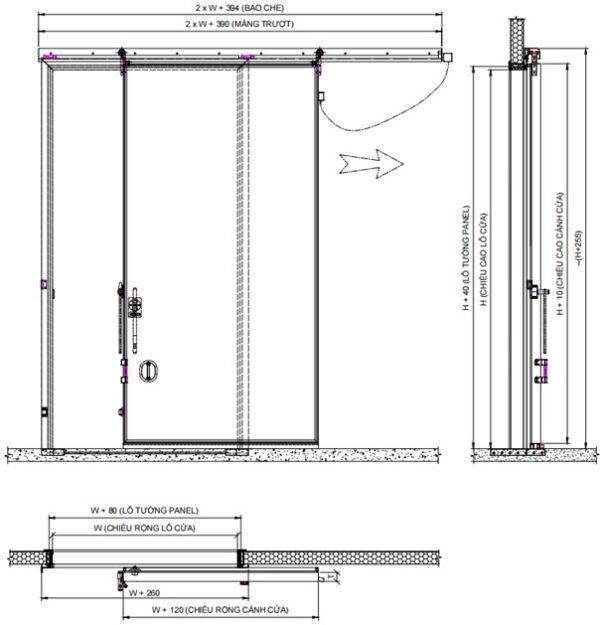
T-Light sliding door model selection table (TLS75 / TLS100 / TLS125)
The table below gives the parameters of each model in the T-Light SERIES, for reference when preparing estimates and when a door of the same type needs replacing later:
| T-LIGHT SERIES | |||
| TLS75 | TLS100 | TLS125 | |
| Application/Temperature Range | |||
| Cool storage (0°C to 8°C) | • | ||
| Cold storage (0°C to -28°C) | • | ||
| Freezer (0°C to -45°C) | • | ||
| Other purposes | • | • | • |
| Size (mm) | |||
| Max Width (Wmax) | 3000 | 3000 | 3000 |
| Max Height (Hmax) | 6000 | 6000 | 6000 |
| Min Width (Wmin) | 900 | 900 | 900 |
| Min Height (Hmin) | 1600 | 1600 | 1600 |
| Door thickness (T) | 75 | 100 | 125 |
| Door | |||
| Stainless steel SUS 304 | Surface 2B, BA, HL, No.4, thickness 0.5mm to 0.8mm | ||
| Color coated steel | RAL color code: 9001, 9002, 9006, 9007, 9010, thickness 0.46mm | ||
| Door frame | |||
| Stainless steel SUS 304 | Surface 2B, BA, HL, No.4 | ||
| Special aluminum | Anodized surface, with thermal bridge cutout | ||
| Heating resistor | • | • | |
| gasket | • | • | • |
| Slider | Special aluminum, anodized surface | ||
| Lever, suspension mechanism | Stainless steel SUS 304/plastic, can be opened from the inside, imported from EU | ||
Advantages of the Tan Long manual sliding door
The T-Light sliding door delivers five specific technical benefits for businesses operating cold storage.
- Optimal insulation: A 40 kg/m³ PU layer combined with an HDPE thermal break frame forms a continuous thermal barrier from the inner to the outer face of the leaf. There is no interrupted conduction path through metal, which is the main cause of condensation and heat loss at the frame.
- Energy saving: When heat loss falls, the refrigeration compressor starts less often to hold the setpoint. In a store running 24 hours a day, this builds into significant electricity savings month by month and year by year.
- High durability: Anodised aluminium, SUS304 stainless steel and engineering plastic resist cleaning chemicals and do not corrode in continuously high humidity. The European suspension set is designed for heavy loads and high opening cycles in industry.
- Light operation: The sliding force is low thanks to high-quality roller bearings, so the operator can open and close with one hand even while wearing protective gloves in a freezer room.
- Meet hygiene standards: The materials are free of toxic contamination and the smooth surface is easy to clean and withstands high-pressure water and chemical cleaning. T-Light suits the requirements of plants certified to HACCP and ISO 22000 and the EU seafood export standards.
Applications of the Tan Long T-Light manual sliding insulated door
The manual sliding insulated door T-Light line is designed specifically to operate stably in three key environment groups: food processing plants, cold storage systems and industrial freezing tunnel areas.
- In meat and seafood processing plants, the T-Light door separates the production zone from the transport corridor. Workers move through frequently and trolleys pass continuously, so the door must operate lightly, slide without much force and recover its seal immediately after each closing. T-Light meets this requirement thanks to a European-quality suspension set and a high-elasticity rubber gasket.
- In chill rooms and cold storage rooms, the job of the door is to hold a stable temperature range from 0°C to -25°C (32°F to -13°F) throughout the cycle of goods moving in and out. T-Light, with PU insulation from 75 mm to 125 mm thick, controls the inward heat flow and reduces how often the compressor starts, lowering the monthly electricity cost.
- In air blast freezing tunnels at deep sub-zero temperatures to -45°C (-49°F), the door has to withstand a large temperature difference between the two sides without deforming and without freezing at the frame and rail. The heater wire built into the T-Light frame stops moisture condensing and freezing at the contact gap, so the door slides smoothly whatever the operating temperature.
Why choose the T-Light manual sliding insulated door from Tan Long
The four points below are all verifiable, not self-assessment:
| Criteria | Details |
|---|---|
| Materials stated openly | SUS304 stainless steel leaf and frame 0.5 – 0.8 mm or RAL colour-coated steel 0.46 mm · PU core at 40 kg/m³ · anodised aluminium frame with a thermal break channel. |
| Imported fittings | Hinges, suspension mechanisms and locks from Stuv, Intertecnica, Imamoglu and MTH (Europe) — with model codes for reference when replacement is needed. |
| Installed in the field | 29 projects since 2005 for seafood plants, food plants and distribution cold stores. See the project portfolio. |
| Same contractor as the cold store itself | Tan Long turnkey cold storage installation, so the door is chosen to match the panel thickness and the temperature range from the design stage, rather than being fitted as an afterthought. |
Scope of work: survey the door opening and temperature range → select the model and leaf thickness → supply and install → adjust the gasket, heater wire and lock mechanism → operator training → periodic maintenance under the contract.
Comparing the 4 types of cold storage door Tan Long supplies
A cold store usually uses more than one type of door: a door for people, a door for forklifts, and a door at the loading and unloading area. The table below compares them on actual parameters so you can choose the right type for each position:
| Door type | Suitable installation position | Maximum size | What to weigh up |
|---|---|---|---|
| T-Light hinged door (TLH) | Personnel access, small and medium rooms | W 1.390 × H 2.850 mm | Lowest investment cost, but needs clearance for the leaf to swing |
| T-Light manual sliding door (TLS) | Forklift access, large openings, high-volume rooms | W 3.000 × H 6.000 mm | Takes no space when open, needs a sliding rail along the wall |
| High-Speed Door | High-traffic passageways between two areas at different temperatures | W 4.000 × H 5.500 mm | Opens at 2.4 m/s and closes at 1.2 m/s, so cold loss drops sharply; it has a motor and a control panel, so it needs periodic maintenance |
| Loading Dock Door | Loading dock area, against the container trailer | To the dock opening size of the building | Seals the gap between the trailer and the warehouse wall, blocking heat and dust during loading and unloading |
Choosing leaf thickness by cold room temperature range
For both the hinged (TLH) and the manual sliding (TLS) lines, the leaf thickness is chosen by the operating temperature of the room, not by the door size:
| Warehouse type | Temperature range | Model | Leaf thickness |
|---|---|---|---|
| Cool storage | 0°C to 8°C | TLH75 / TLS75 | 75 mm |
| Deep-freeze store | 0°C to -28°C | TLH100 / TLS100 | 100 mm |
| Freezer | 0°C to -45°C | TLH125 / TLS125 | 125 mm |
From 100 mm upwards, the door is fitted with heater wire in the frame to keep the gasket and frame from freezing at sub-zero temperatures. Choosing too little thickness is the most common reason doors collect moisture, build up frost and lose gasket contact after only a few seasons of operation.
Comparison with other cold storage door types
The manual sliding door saves space but operates more slowly. Depending on the position in the cold store, consider:
- T-Light hinged door — a simpler structure at a lower cost, suited to positions that are opened rarely.
- High-Speed Door — for forklift routes in continuous use, where opening and closing speed determines the electricity bill.
- Loading dock door assembly — for the position adjoining the truck, where airtightness against the trailer is required.
Xem an overview of the four cold storage door types and how to choose by position.
Frequently asked questions about cold room sliding doors
When should a sliding door be chosen instead of a hinged door?
Choose a sliding door when the opening is large or there is no room in front of the door for a leaf to swing out. The T-Light manual sliding door reaches 3,000 × 6,000 mm, which suits forklift routes and the main door of a high-volume store. Hinged door is limited to 1,390 × 2,850 mm and costs less, which suits personnel access.
Should the leaf be 75, 100 or 125 mm thick?
By the operating temperature of the room: TLS75 (75 mm) for chill rooms at 0°C to 8°C, TLS100 (100 mm) for cold rooms at 0°C to -28°C, TLS125 (125 mm) for freezer rooms at 0°C to -45°C. From 100 mm upwards the door has heater wire in the frame and the rail to prevent freezing.
What are the maximum and minimum sliding door sizes?
Width from 900 mm to 3,000 mm, height from 1,600 mm to 6,000 mm. The door is built to the actual opening within this range. One point to note at design stage: the wall beside the door must be long enough to take the leaf when fully open.
What type of suspension and sliding rail is used?
A dedicated anodised aluminium sliding track profile carries the entire weight of the leaf. The suspension set is imported from Intertecnica, Imamoglu or MTH (Europe). The inner and outer lever handles are SUS304 stainless steel combined with engineering plastic to resist corrosion from cleaning chemicals.
Does a sliding door jam on the rail at sub-zero temperatures?
This is a common fault when the rail is not heated. The T-Light line from 100 mm upwards has heater wire dedicated to refrigeration use fitted in the frame and the rail, preventing freezing at the contact point. If a door is already jamming, check the heater wire and the elasticity of the gasket before considering replacing the suspension set.
How do a manual sliding door and a high speed door differ in where they are used?
The manual sliding door is opened by hand, which suits walkways with moderate traffic. High-Speed Door has a motor, opens at 2.4 m/s and closes at 1.2 m/s, and is used for continuously busy passageways where the time the door stays open is the main cause of cold loss. Many plants fit both, in two different positions.
Request consulting and a cold storage door quotation
Send us the door size (width × height), the operating temperature range of the room and the installation position so Tan Long can select the right model and leaf thickness. Call 0933 357 058 (Mr. Thinh) or send a quotation request.
Technical standards applied to cold room sliding doors
Equipment supplied by Tan Long is manufactured to the following standards and material requirements:
- HACCP
- ISO
- TCVN
- SUS 304 stainless steel
- polyurethane insulation
Depending on each project's requirements, the engineering team will advise on the material configuration and connection standards that best suit the plant's existing system.
The cold room sliding door consulting and supply process at Tan Long
Tan Long controls both design and manufacture at its plant in Duc Hoa 1 Industrial Park, Tay Ninh (formerly Long An), so the investor deals with a single point of contact from survey to handover:
- Survey and requirement definition: engineers work directly at the plant to establish capacity, layout, refrigerant and real operating conditions.
- Technical proposal: calculating a suitable configuration and discussing it with the investor's technical team before it is fixed.
- Detailed design: drawings are prepared and materials and equipment selected to match the refrigerant and the operating temperature range.
- Manufacture and works testing: machining, assembly and a test run before the unit leaves the factory.
- Installation and acceptance: connection into the plant's system, load testing and handover with the technical documentation.
- Warranty and operating support: operating instructions for the plant's technical team and fault support during the warranty period.
Related technical reading
- Vietnam cold storage market 2026: potential and investment opportunities
- Fire safety for cold stores: TCVN regulations and optimal technical solutions
- How to select compressor capacity for a cold store correctly
- How to install insulated panels: the correct process for walls and ceilings
- How to build a cold store: design and installation to industrial standards


